











The safest way to buy medical scrubs online is to compare personal body measurements with the size chart for the specific garment, then review its cut, rise, inseam, fabric stretch, pocket layout, and return policy. A familiar size label is only a starting point because scrub tops, pants, jackets, and different collections may follow different proportions.
Online shoppers should choose scrubs according to how the garments need to perform at work, not simply how they look in product photographs.
Quick Answer
Before ordering medical scrubs online:
- Measure the chest, waist, hips, and inseam.
- Use the size chart provided for the specific garment.
- Check whether the chart lists body or garment measurements.
- Review the top cut, pant rise, leg shape, and available lengths.
- Confirm the fabric composition and stretch description.
- Match pocket placement to actual work needs.
- Read the return and exchange policy before purchasing.
- Order one set before buying a complete workwear rotation.
- Test the scrubs while sitting, reaching, walking, and bending.
- Keep a record of the styles and measurements that fit correctly.
The best online scrub purchase is not necessarily the usual size. It is the garment whose measurements, proportions, and work features match the wearer.
Why Is It Difficult to Buy Medical Scrubs Online?
Online shopping removes the opportunity to feel the fabric, compare several cuts in a fitting room, and immediately test how a garment moves.
Product photographs may show:
- One body type
- One height
- One styling method
- One pant length
- A garment that has been adjusted for photography
The same scrub set may fit differently on someone with a longer torso, broader shoulders, shorter inseam, fuller hips, or different waist-to-hip proportions.
Another challenge is that medical scrubs are functional workwear. A top that appears attractive in a standing photograph may pull across the shoulders during reaching. Pants that look properly fitted may create waistband pressure after prolonged sitting.
Online shoppers therefore need to evaluate both size and workplace function.
Start With the Job, Not the Size Chart
Before looking at size options, identify what the scrub set needs to do during a normal shift.
Consider:
- How much walking is involved?
- Is frequent bending or reaching required?
- Are long periods spent sitting?
- Is the workplace usually warm or cool?
- Are additional layers worn?
- Which items need to be carried?
- Does the employer require a specific color?
- Are embroidery or department markings required?
- Is a fitted or relaxed appearance preferred?
- Are certain pant styles restricted?
A scrub set for an outpatient office may have different priorities from one used in emergency care, long-term care, veterinary work, dentistry, or home healthcare.
Professionals browsing a medical scrubs online store should establish these requirements before filtering by color, price, or appearance.
Take Current Body Measurements
Accurate measurements provide a better starting point than relying on the size printed inside an older garment.
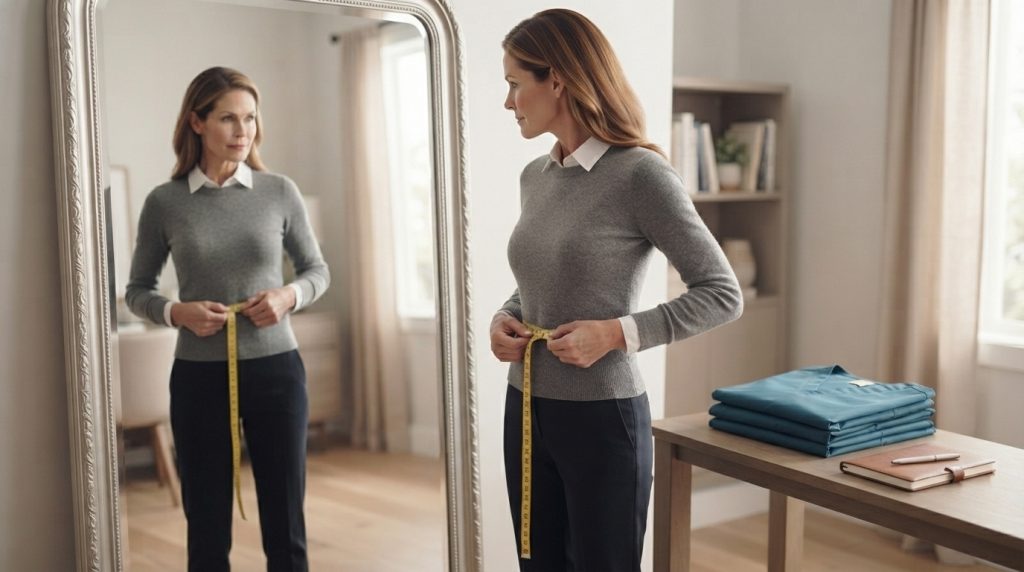
Apparel-sizing standards are built around body dimensions and size designations, which is why current measurements are more useful than assuming a familiar letter size will fit every garment. The National Institute of Standards and Technology has published resources covering body dimensions for apparel sizing, including measurement terminology and sizing applications.
Use a flexible measuring tape and wear light clothing.
The tape should remain level and comfortably close to the body without being pulled excessively tight.
Measure the Chest or Bust
Measure around the fullest area of the chest or bust.
Keep the tape:
- Level across the back
- Comfortable under the arms
- Parallel to the floor
- Close without compressing the body
This measurement helps evaluate scrub tops, jackets, and lab coats.
Measure the Natural Waist
Measure around the natural waistline.
This is usually the narrower area of the torso, but body proportions differ. Avoid measuring only where a preferred pair of pants happens to sit unless the product chart specifically requests that location.
Measure the Hips
Measure around the fullest area of the hips and seat.
This measurement is especially important for:
- Fitted scrub pants
- Joggers
- Tapered pants
- Maternity styles
- Shaped scrub tops
- Jackets that extend below the hip
Measure the Inseam
Measure from the crotch seam down the inside of the leg to the preferred hem position.
The easiest approach is often to measure a pair of work pants that already fits correctly.
New Mexico State University’s fitting guidance recommends taking several lower-body measurements, including the waist, hips, thigh, knee, and pant length, because proper pant fit depends on more than one dimension.
Record Height and Torso Length
Height alone does not determine whether someone needs petite, regular, or tall scrubs, but it can provide helpful context.
Torso length also matters because two people of the same height may have very different:
- Top lengths
- Rise requirements
- Sleeve preferences
- Inseams
Record measurements in a note that can be updated when needed.
Understand the Difference Between Body and Garment Measurements
A size chart may show either:
- Body measurements
- Finished garment measurements
These are not the same.
Body Measurements
A body measurement chart tells shoppers which size is intended for a particular chest, waist, or hip range.
For example, the chart may recommend a medium for a defined hip range.
Garment Measurements
A garment measurement chart lists the actual dimensions of the clothing.
A scrub top may have a chest measurement larger than the wearer’s body because clothing requires room for movement.
Why Ease Matters
The difference between body measurement and garment measurement is often called ease.
Scrubs need enough ease to allow:
- Sitting
- Reaching
- Walking
- Bending
- Layering
- Pocket use
Too little ease can create restriction. Too much can cause the garment to shift, bunch, or appear oversized.
When the product page is unclear, customer service may be able to confirm whether the chart represents the body or the garment.
Do Not Assume the Same Size Will Fit Every Scrub Style
Different garment cuts distribute space differently.
A person may wear:
- One size in a relaxed top
- Another size in a fitted top
- A different size in a jacket
- One pant size in a jogger
- Another in a straight-leg style
This does not necessarily indicate inconsistent shopping habits. It reflects differences in garment construction.
Important variables include:
- Shoulder width
- Armhole shape
- Chest allowance
- Waist shaping
- Hip room
- Pant rise
- Thigh width
- Leg taper
- Fabric stretch
Always review the chart for the exact item rather than using a single size across the entire website.
How Should a Scrub Top Fit?
A scrub top should provide professional coverage while allowing unrestricted upper-body movement.
Check the Shoulders
The shoulders are one of the most important fit areas.
A top may be too small if it:
- Pulls across the upper back
- Feels tight under the arms
- Restricts forward reaching
- Lifts excessively when the arms rise
- Creates tension at the sleeve seams
A top may be too large if:
- The shoulder seams fall too far down the arms
- The neckline shifts while bending
- Excess fabric gathers under the arms
- The pockets become difficult to reach
- The garment moves independently of the body
Review Chest and Torso Shaping
Product descriptions may use terms such as:
- Contemporary fit
- Modern fit
- Classic fit
- Relaxed fit
- Tailored fit
- Shaped fit
- Unisex fit
These terms are useful, but they are not universal measurements.
Compare the listed chest, waist, and hip ranges with the desired level of room.
Check Top Length
The scrub top should remain long enough for coverage during reaching and bending.
However, a top that is too long may:
- Block pant pockets
- Bunch when sitting
- Pull across the hips
- Create bulk under a jacket
Side vents can provide additional room through the hip area.
Review the Neckline
V-neck, round-neck, notched, mock-wrap, and zip-neck tops can provide different levels of coverage.
Product photographs should be reviewed from several angles when available.
Also consider:
- Whether an underscrub will be worn
- Whether the neckline shifts while bending
- Whether the facility has coverage requirements
- Whether an identification badge affects the neckline
How Should Scrub Pants Fit?
Scrub pants require attention to the waist, hips, rise, thighs, knees, leg shape, and inseam.
A correct waist measurement alone does not guarantee a good fit.
Waistband Fit
Common waistband styles include:
- Full elastic
- Drawstring
- Elastic with drawstring
- Yoga-style knit waistband
- Rib-knit waistband
- Flat front with elastic sections
A waistband should remain secure without causing strong pressure.
Shoppers who carry items in pant pockets may prefer an adjustable drawstring or hybrid waistband to help support the additional weight.
Pant Rise
Rise determines how the pants sit between the waistband and crotch.
A rise that is too short may:
- Pull while sitting
- Create pressure through the crotch
- Slide downward while bending
A rise that is too long may:
- Bunch below the waist
- Create excess fabric
- Feel loose through the seat
Review terms such as mid-rise, natural-rise, and high-rise together with product photographs and measurements.
Hip and Thigh Room
Tapered and jogger-style pants may fit closely through the hips and thighs.
Check whether the fabric includes stretch and whether the size chart provides enough room for sitting and bending.
Visible horizontal pulling lines often suggest insufficient room.
Knee and Calf Fit
A narrow leg opening may fit differently depending on calf size.
This is especially important with:
- Joggers
- Slim tapered pants
- Compression-inspired fits
- Elastic ankle cuffs
A pant may fit at the waist and hips while still feeling restrictive through the lower leg.
Petite, Short, Regular, or Tall: Which Length Is Correct?
Length labels should never be chosen by height alone.
The wearer’s leg length, torso proportions, rise preference, footwear, and pant style all affect the decision.
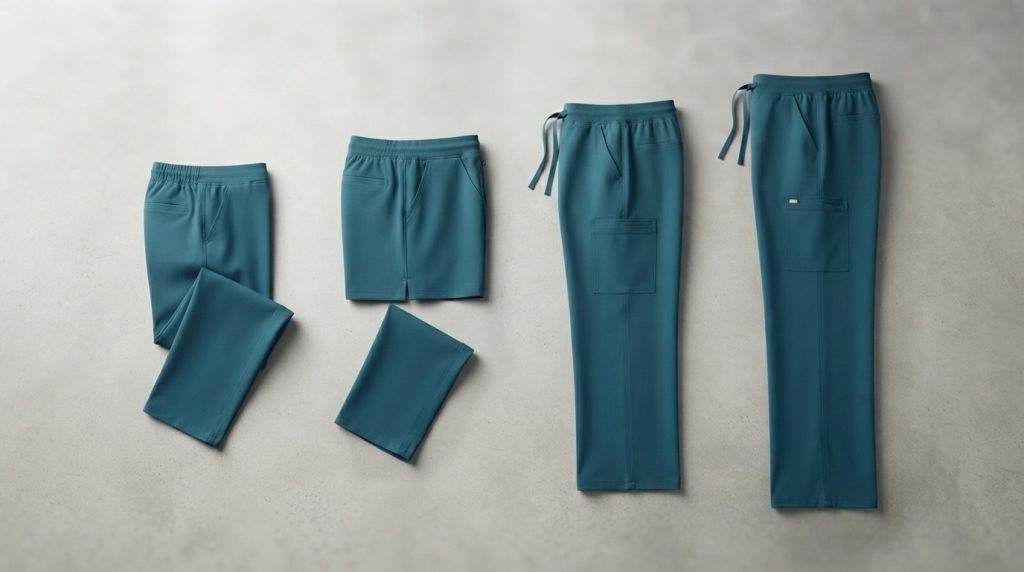
Petite Scrub Pants
Petite sizing may adjust more than the hem.
Depending on the collection, petite scrub pants may include changes to:
- Inseam
- Rise
- Knee placement
- Leg taper
- Overall proportion
Petite can be useful for wearers who find that regular pants bunch at the knee, create excessive rise, or drag at the hem.
Short-Length Scrub Pants
Short sizing may primarily reduce the inseam while keeping other proportions similar to regular sizing.
This can suit shoppers who need a shorter leg length but not necessarily a petite rise or adjusted knee position.
Regular-Length Scrub Pants
Regular sizing is designed around the manufacturer’s standard inseam and proportions.
It should not be selected automatically. Always compare the actual measurement with a well-fitting pair of pants.
Tall Scrub Pants
Tall scrub pants may include a longer inseam and, in some collections, adjustments to the rise or knee placement.
Tall sizing may be appropriate when regular pants:
- Rise too far above the ankle
- Pull upward while sitting
- Position the knee shaping incorrectly
- Fail to cover the top of the shoe appropriately
Measure Instead of Guessing
Use an existing pair of correctly fitting work pants.
Measure:
- The inseam
- The front rise
- The back rise
- The waistband width
- The thigh width
- The leg opening
These measurements create a practical reference for online comparison.
Choose the Right Scrub Pant Style
Leg shape affects appearance, mobility, footwear compatibility, and fit.
Jogger Scrub Pants
Joggers narrow toward the ankle and often use a cuff.
They may appeal to wearers who prefer:
- Less loose fabric near the shoe
- A modern silhouette
- A defined ankle
- Athletic-inspired workwear
Check cuff comfort and calf width carefully.
Tapered Scrub Pants
Tapered pants gradually narrow toward the lower leg without necessarily using an elastic cuff.
They can provide a streamlined appearance with a traditional hem.
Straight-Leg Scrub Pants
Straight-leg pants maintain a more consistent width through the leg.
They may provide additional calf room and a classic professional appearance.
Cargo Scrub Pants
Cargo pants include additional thigh storage.
Consider whether the cargo pocket position will remain comfortable while sitting or walking.
Flare and Bootcut Scrub Pants
These styles widen below the knee.
They may require more careful inseam selection because a long hem can drag near the floor or footwear.
Read the Fabric Composition
Fabric composition helps shoppers understand what the garment contains, although fiber percentages alone do not predict the complete feel or performance.
The Federal Trade Commission explains that most textile products must include labels identifying their fiber content and other required information. Checking these details can help shoppers compare materials rather than relying only on marketing terms.
Common scrub fibers include:
- Polyester
- Cotton
- Rayon or viscose
- Spandex or elastane
- Nylon
Polyester
Polyester can contribute to:
- Shape retention
- Wrinkle resistance
- Faster drying
- Smooth texture
- Color durability
Cotton
Cotton may add:
- Softness
- A familiar textile feel
- A less synthetic surface
- Moderate structure
Rayon or Viscose
Rayon-type fibers may contribute:
- Soft drape
- Flexibility
- Smooth texture
- Lightweight comfort
Spandex or Elastane
Stretch fibers can improve mobility and recovery.
A small percentage may provide useful flexibility, but the complete fabric construction matters more than the number alone.
How Much Stretch Is Enough?
Product pages may describe fabric as:
- Two-way stretch
- Four-way stretch
- Mechanical stretch
- Flexible
- Performance stretch
- Ultra-stretch
These labels are helpful, but shoppers should also consider the garment cut.
A fitted pant may need more stretch than a relaxed straight-leg pant.
A useful scrub fabric should:
- Move during sitting and bending
- Return to its original shape
- Avoid excessive sagging
- Maintain coverage under tension
- Feel comfortable over several hours
When reviews are available, look for repeated comments about:
- Knee bagging
- Waistband stretching
- Fabric cling
- Transparency
- Loss of shape
- Restriction through the shoulders or thighs
One isolated review may reflect individual preference. Repeated comments can reveal a more consistent fit pattern.
Evaluate Pocket Placement Before Ordering
The total pocket count does not always indicate usefulness.
A scrub set with fewer well-positioned pockets may be more practical than one with many compartments that are difficult to access.
Scrub Top Pockets
Possible options include:
- Chest pocket
- Lower patch pockets
- Interior compartments
- Pen slots
- Zippered pockets
- Hidden phone pockets
Consider whether the pocket remains accessible under a jacket or lab coat.
Scrub Pant Pockets
Possible options include:
- Front slash pockets
- Back pockets
- Cargo pockets
- Zippered thigh pockets
- Small utility compartments
Think about what will actually be carried.
Heavy objects can cause:
- Waistband slipping
- Uneven fabric pull
- Pocket sagging
- Discomfort while sitting
Choose storage based on routine needs rather than maximum pocket quantity.
Check Product Photographs Carefully
Product images can provide useful fit information when reviewed beyond the main front-facing image.
Look for:
- Front, side, and back views
- Seated or movement photographs
- Close-ups of waistbands
- Pocket placement
- Side vents
- Ankle openings
- Jacket cuffs
- Fabric texture
- Top length relative to the hips
When model information is provided, compare the model’s height and worn size with personal measurements.
Do not expect the same garment to fall identically on a different body proportion.
Read Product Descriptions for Specific Fit Clues
Useful wording may include:
- Runs fitted through the hip
- Relaxed through the thigh
- Tapered leg
- High-rise waistband
- Contemporary fit
- Longer back hem
- Side vents
- Tuckable design
- Knit side panels
- Slim sleeve opening
- Adjustable drawstring
These details are often more informative than a general description such as “comfortable fit.”
Use Reviews Carefully
Customer reviews can help identify recurring fit patterns.
Search reviews for terms such as:
- Runs small
- Runs large
- True to size
- Tight in the shoulders
- Roomy through the hips
- Short rise
- Long inseam
- Narrow calf
- Waistband rolls
- Fabric stretches out
- Fabric feels heavy
- Fabric feels thin
Reviews are subjective, so they should be considered alongside measurements and product information.
A review from someone with similar proportions may be more helpful than a general statement that the product fits well.
Read the Return and Exchange Policy Before Ordering
Return rules are part of the buying decision, especially when trying a new collection.
The Federal Trade Commission advises online shoppers to check refund policies, return deadlines, restocking charges, and responsibility for return shipping before completing a purchase.
Confirm:
- How many days are allowed
- Whether items must be unworn
- Whether tags must remain attached
- Whether sale items are final
- Who pays return shipping
- Whether exchanges are available
- Whether embroidery changes eligibility
- Whether clearance products can be returned
- Whether shipping charges are refundable
Do not remove tags, wash, embroider, or wear scrubs to work until the fit has been approved.
Order One Set Before Building a Full Rotation
When trying a new brand or collection, order one top and one pant first.
Test them before purchasing several sets.
This reduces the risk of ending up with multiple garments that share the same fit problem.
Once a reliable combination is found, record:
- Brand or collection
- Top style
- Top size
- Pant style
- Pant size
- Length
- Color
- Fabric composition
- Preferred features
A simple fit record makes future online ordering faster and more consistent.
How Should New Scrubs Be Tested at Home?
Try the garments with normal work underlayers and footwear.
Keep tags attached during the initial fit test.
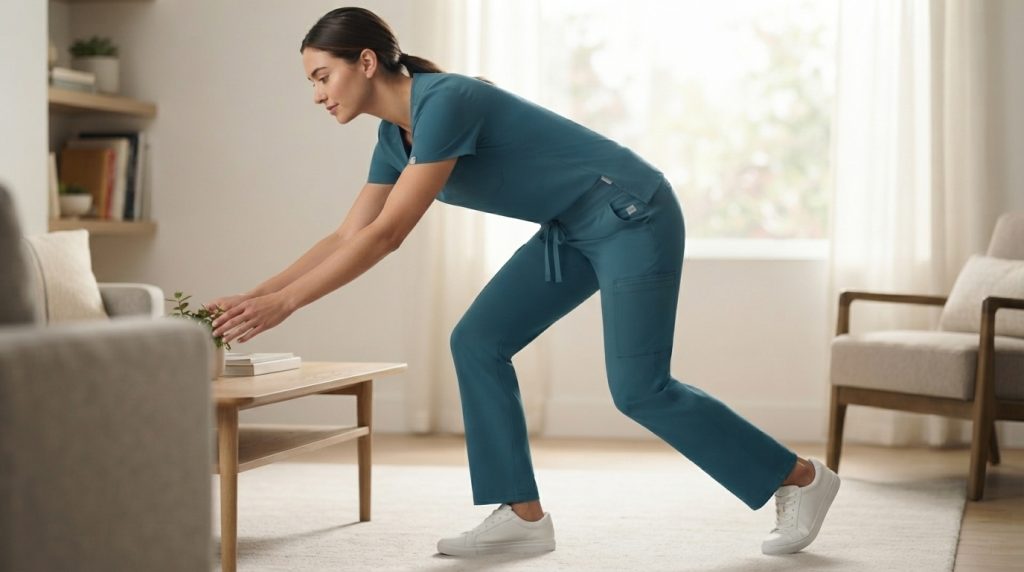
The Online Scrub Fit Test
- Stand naturally.
- Sit fully in a chair.
- Reach both arms forward.
- Raise both arms overhead.
- Bend carefully.
- Squat or lower the body slightly.
- Walk quickly.
- Raise one knee.
- Place lightweight items in the pockets.
- Add a normal work jacket or lab coat.
Check the Scrub Top
Confirm that:
- The shoulders do not pull
- The neckline remains secure
- The top provides coverage while bending
- The hem does not rise excessively
- The pockets remain accessible
- The fabric does not strain across the chest or hips
Check the Scrub Pants
Confirm that:
- The waistband remains secure
- The rise feels comfortable
- The hips and thighs allow movement
- The knees do not feel restricted
- The hem does not drag
- The inseam remains appropriate while sitting
- Loaded pockets do not pull the pants downward
When uncertainty remains, an in-person fitting at a medical scrub store in Lincoln can help clarify whether the issue is size, cut, rise, fabric, or inseam.
Common Online Scrub Shopping Mistakes
Choosing by Usual Size Alone
A familiar size label does not replace the item-specific chart.
Ignoring Pant Rise
Waist and hip measurements may be correct while the rise remains uncomfortable.
Selecting Length by Height Only
Body proportions can make petite, short, regular, or tall sizing appropriate at unexpected heights.
Buying Several Sets Immediately
Test one set before committing to a complete rotation.
Assuming Stretch Solves Every Fit Problem
Stretch cannot correct an incorrect shoulder width, rise, inseam, or garment proportion.
Overlooking Pocket Weight
Pants may fit differently when phones, pens, or other items are added.
Ignoring the Return Policy
Embroidery, washing, removed tags, or final-sale status may affect return eligibility.
Judging Fit Only While Standing
Many fit problems appear only during sitting, bending, and reaching.
Ordering for Appearance Instead of Role
The garment needs to suit the workplace, dress code, storage needs, temperature, and movement demands.
How to Build a Reliable Online Scrub Profile
After finding a successful fit, create a personal ordering profile.
Record:
| Fit Detail | Information to Save |
| Scrub top | Style, size, chest fit, top length and neckline |
| Scrub pants | Style, size, rise, inseam and leg shape |
| Fabric | Fiber blend, stretch and preferred weight |
| Pockets | Most useful placements and minimum requirements |
| Waistband | Preferred construction and adjustability |
| Work layers | Underscrub, jacket or lab coat compatibility |
| Color | Exact workplace-approved shade |
| Care | Washing and drying requirements |
This information is more useful than relying on memory or repeating the same general size across unrelated garments.
Final Thoughts
Buying medical scrubs online becomes much easier when the process is based on measurements, proportions, and work requirements.
Start by measuring the body and a well-fitting garment. Then review the product-specific size chart, scrub-top cut, waistband, rise, inseam, leg shape, fabric composition, stretch, and pocket placement.
The most important rule is simple:
Do not buy the size that normally sounds right. Buy the garment whose measurements and construction match the wearer’s body and workday.
A careful first order can prevent repeated returns and create a dependable reference for future scrub purchases.
Frequently Asked Questions
Should medical scrubs be ordered one size larger?
Not automatically. Scrubs should provide enough room for movement without becoming excessively loose. Compare current chest, waist, hip, and inseam measurements with the product-specific size chart. A larger size may create problems such as slipping waistbands, oversized shoulders, or excess fabric.
How can someone know whether online scrubs run small?
Review the size chart, garment measurements, fit description, model information, and repeated customer-review patterns. Comments about tight shoulders, narrow thighs, short rise, or limited stretch may indicate that the cut feels smaller in specific areas rather than uniformly small.
What measurements are needed to buy scrub pants online?
The most useful measurements are the waist, hips, inseam, rise, thigh, and preferred leg opening. Comparing these with a well-fitting pair of work pants can be more reliable than using height or letter size alone.
Are petite and short scrub pants the same?
Not always. Short-length pants may mainly reduce the inseam, while petite sizing may also adjust the rise, knee position, and overall proportion. The exact construction depends on the manufacturer, so the specific chart and description should be checked.
How should tall scrub pants fit?
Tall scrub pants should provide enough inseam length without creating excess fabric through the rise or knees. The hem should remain appropriate while standing and sitting and should not drag under the shoe.
Should scrubs be washed before checking the fit?
No. Check the fit while the scrubs are unworn, unwashed, and still tagged. Washing may affect return eligibility. Once the garments have been accepted, follow the care instructions printed on the label.
Is it better to buy matching scrub tops and pants?
Matching pieces from the same collection may provide consistent fabric and color, but the same size is not always needed for both. Many professionals require different top and pant sizes. Fit should take priority over ordering a single matching size.